


THE AETHERIC SOCIETY HERALD #650
J.L. Ashcroft Publication Project
J.L. Ashcroft (1957–?) was never meant for the public eye. For most of his life, he existed quietly—publishing strange tales in tiny local print runs, scrawling sigils into the margins of his books, and disappearing for months at a time into the forests of the Pacific Northwest. A reclusive writer, student of metaphysics, and speculative folklorist, his unpublished work often straddled the line between cosmic horror and visionary fiction.
Ashcroft’s career burned briefly but brilliantly during the mid-1970s through early ’80s, producing manuscripts, field notes, and letters that circulated through private collections long after he vanished from public view. Many of these pages were never formally released until recently.
He was affiliated—informally—with fringe research circles, including the Aetheric Society, where early writings sparked fascination and debate. He once described his imagination as
“a cracked lens looking into something real, but too old to name.”
CLICK TO READ MORE!


Who are we?
Founded in 1907, The Aetheric Society is a privately funded research collective based in Lily Dale, New York.
Originally formed to investigate altered states of consciousness, anomalous frequency patterns, and fringe metaphysics, the Society has quietly published papers and monographs on topics ranging from dreamwave mapping to quantum-memory resonance.
Our members have contributed to early sound therapy experiments, para-acoustic engineering, and the development of psychometric writing frameworks. Some of these contributions remain unpublished.

Annual Winter Assembly, c.1911
Founding Fathers & Society Leaders
Samuel Spengler—an eccentric and self-proclaimed ghost-hunting engineer who operated in the early to mid 1800s using unorthodox methods that blended psychology, acoustics, early wave theory, and spiritualist technology.
Samuel’s extensive notes and field journals were lost in a mysterious fire, but some pages survived and were passed down through his family.
The Aetheric Society was founded in the early 20th century by Elias Spengler, the great-grandson of Samuel.

Samuel Spengler, c.1880s

Elias Spengler,
c.1911
Elias Spengler was the founder of the Aetheric Society
Head of the society from its founding to his death in 1957.
Born into a family already burdened by strange inheritance, Elias discovered the surviving Spengler journals as a teenager and became obsessed with reconstructing the fragmented system of thought they described.
Drawing from early psychology, wave theory, ritual practice, acoustics, and private spiritualist records, he began to formalize a new field of inquiry centered on consciousness under pressure, emotional resonance, and the persistence of memory beyond ordinary perception.
In 1907, Elias established the Aetheric Society in Lily Dale, New York, envisioning it as both archive and laboratory.
Under his direction, the Society investigated altered states of consciousness, para-acoustic therapy, dreamwave mapping, symbolic architecture, and what later internal documents would refer to as “lattice events”—moments in which grief, pattern, memory, and environment appeared to converge into a single anomalous phenomenon.
Thaddeus Graves was the first non-spengler to head The Aetheric Society from 1957 to 1999

Thaddeus Graves, c.1968
Marsha Potts is the first woman to head The Aetheric Society. She has been from 1999 to the current day

Marsha Potts, c.1999
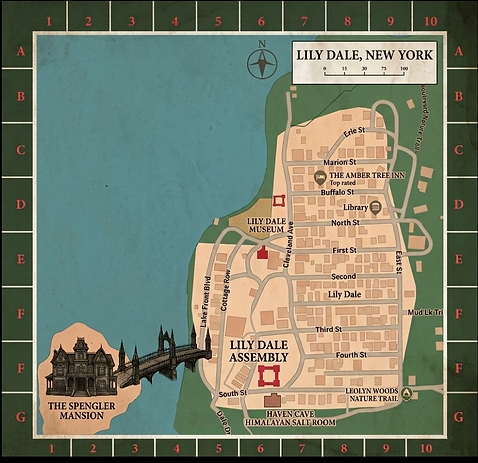
Located In Lily Dale, New York

TAKEN 1890

TAKEN 1982
The Aetheric Society is headquartered in Lily Dale, New York—locally nicknamed 'Silly Dale' due to its longstanding association with spiritualism.
They operate from an old farmhouse used since the 1890s for séances , on the outskirts of town by a lake. Samuel Spengler claimed it was perfectly aligned with anomalous magnetic frequencies and forgotten ley lines.
Research Divisions
Division of Acoustic & Resonance Studies (D.A.R.S.)
Research into frequency entrainment, harmonic induction, and anomalous auditory perception.
Bureau of Dreamwave Cartography & Liminal Architecture (B.D.C.L.A.)
Studies sleep-state phenomena, symbolic drift, oneiric patterning, and recovered dream correspondence, with additional focus on the relationship between physical space, memory distortion, perception, and ritual geometry.
Office of Cognitive Signal Analysis (O.C.S.A.)
Examines anomalous pattern recognition, symbolic recurrence, suggestion pathways, narrative-triggered response, and the interpretive analysis of emotionally significant texts.
Division of Mourning-State Research (D.M.S.R.)
Studies grief susceptibility, residual emotional fields, and consciousness under extreme emotional pressure.
Department of Convergence Events (D.C.E.)
Catalogues rare moments in which environment, memory, perception, and symbolic recurrence appear to align.
Archive Red / Restricted Holdings (A.R.)
Maintained under Montrose Observation Group authority
Internal division overseeing sealed publications, classified field notes, and ethically sensitive Society material.
All divisions are operated out of The Historical Spengler Mansion

The Spengler Mansion c.2025
Notable Members from around the globe
Elias Spengler
Founder of the Aetheric Society and principal archivist of the Spengler family journals. Spengler is remembered for formalizing the Society’s earliest studies in altered consciousness, symbolic systems, and psychometric writing.
Samuel Spengler
Though never formally affiliated with the Society, Samuel Spengler’s field journals and experimental apparatus heavily influenced its founding principles. His work blended early acoustics, observational psychology, and spiritual inquiry.
Dr. Marian Vale
Physician and early researcher in sleep states, emotional memory, and therapeutic listening practices. Vale’s surviving notes are regarded as foundational to the Society’s studies in dreamwave mapping.
Theodore Bell
Electrical engineer and communications specialist whose technical contributions helped modernize the Society’s experimental sound and signal equipment during the mid-20th century.
Agnes Wren
Field observer and sensitive consultant known for her work in impression-based site readings, emotional atmosphere studies, and anomalous case documentation.
Lucian Grove
Architectural theorist whose research focused on the relationship between environment, perception, and symbolic space. Grove’s work remains influential in discussions of liminal design.
Dr. Corwin Pike
Systems engineer and postwar research consultant associated with early studies in signal repetition, cognition, and environmental influence.
Dr. Helena March
Psychologist and researcher in symbolic suggestion, altered states, and guided memory response. March’s later papers remain partially unpublished.
Warren Vale
Technologist and systems planner who helped transition the Society into the modern era through digitization, indexing, and pattern analysis methodologies.
Silas Reed
Broadcaster and para-acoustic theorist whose experimental work explored the relationship between sound, attention, and unusual perceptual states.
Dr. Felix Rainer
Mathematician and theorist known for his work on convergence events, memory geometry, and anomalous pattern formation in emotionally charged environments.
Preston Hale
Controversial researcher associated with remote perception theory, youth cognition studies, and archival material later restricted by the Society.
Adrian Sol
Contemporary investor and technological patron whose support has renewed Society interest in consciousness studies, systems modeling, and emergent cognitive frameworks.
Mira Quill
Symbolic systems analyst and machine-learning specialist involved in the Society’s contemporary pattern-recognition and narrative-response projects.
Jonah Vey
Neuro-interface entrepreneur and consultant on machine-assisted synchronization, with particular interest in the boundary between cognition, affect, and signal behavior.