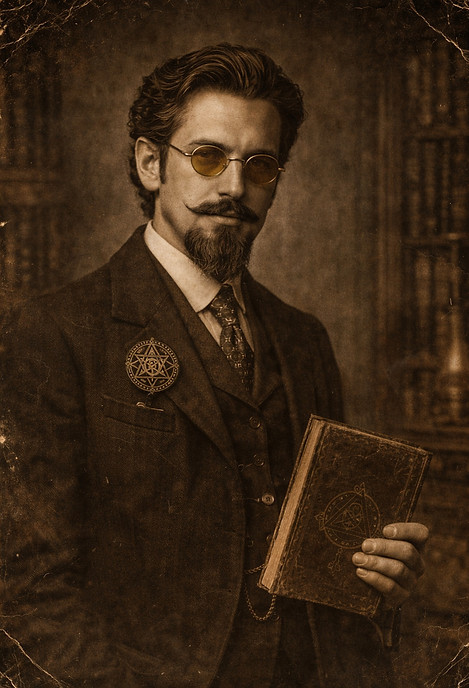
Elias Spengler was the founder of the Aetheric Society and the great-grandson of Samuel Spengler, an eccentric investigator-engineer whose experiments in spiritual acoustics, psychical apparatus, and anomalous field observation laid the groundwork for the Society’s earliest doctrines.
Born into a family already burdened by strange inheritance, Elias discovered the surviving Spengler journals as a teenager and became obsessed with reconstructing the fragmented system of thought they described.
Drawing from early psychology, wave theory, ritual practice, acoustics, and private spiritualist records, he began to formalize a new field of inquiry centered on consciousness under pressure, emotional resonance, and the persistence of memory beyond ordinary perception.
In 1907, Elias established the Aetheric Society in Lily Dale, New York, envisioning it as both archive and laboratory. Under his direction, the Society investigated altered states of consciousness, para-acoustic therapy, dreamwave mapping, symbolic architecture, and what later internal documents would refer to as “lattice events”—moments in which grief, pattern, memory, and environment appeared to converge into a single anomalous phenomenon.
Though publicly regarded as a fringe academic and private researcher, internal records portray Elias as increasingly severe, withdrawn, and consumed by the belief that consciousness could be tuned, traced, and in rare circumstances, synchronized across individuals. Several of his later papers were classified by the Society itself and remain only partially recoverable.