


Division of Acoustic & Resonance Studies (D.A.R.S)
Codename: The Spengler Legacy
Public Function
Research into frequency entrainment, harmonic induction, anomalous auditory perception, and the physiological effects of sustained resonance exposure.
Internal Scope
The Division of Acoustic & Resonance Studies maintains active research into the relationship between sound, consciousness, physical healing, symbolic recurrence, and threshold activation. Internal doctrine holds that resonance is not merely a sensory phenomenon, but a structuring force capable of altering cognition, perception, biology, and, under extreme conditions, spiritual receptivity.
D.A.R.S. treats sound as both:
A carrier medium
And a "Destabilizing Key"
The division’s foundational premise is that the human body, when properly tuned, may become receptive to frequencies beyond ordinary cognition. Early Spengler documents refer to these harmonics as the higher register.
Foundational Principle
Acoustic exposure is understood to operate along three escalating bands:
Somatic Band — affects body, pain response, tissue stress, and autonomic state
Cognitive Band — affects memory, emotion, perception, and symbolic bleed
Threshold Band — affects spiritual receptivity, identity continuity, and non-local contactThe Society’s formal position is that the Threshold Band remains unstable but reproducible under controlled chamber conditions.
Seraphim Exposure Trials
The Seraphim Exposure Trials represent the division’s most ambitious and controversial attempt to induce direct contact through sustained harmonic saturation. Subjects were seated in specially designed resonance chambers equipped with:
Brass acoustic funnels
Standing-wave emitters
Tuning arrays
Primitive waveform projectors
Sacramental geometrY
and chamber-wall reflection surfaces designed to amplify and fold tonal structures back through the seated body
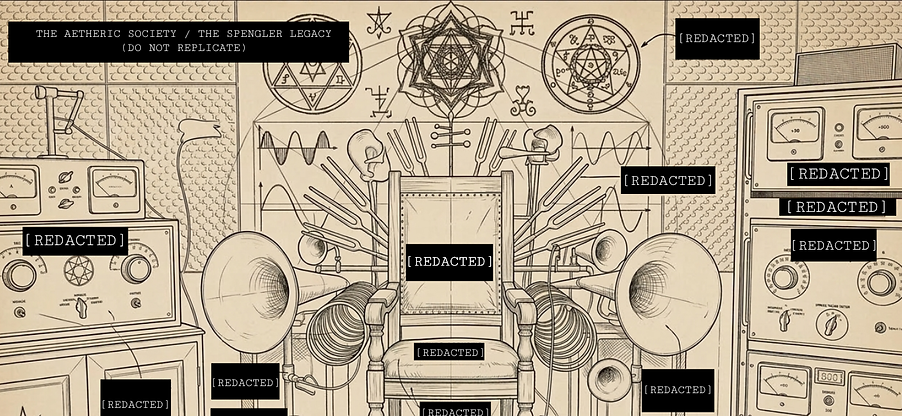
The chambers were built around the belief that certain harmonic configurations could produce:
Healing
Clairaudience
Symbolic unlocking
and contact with benevolent or supra-human intelligences
Early low-exposure subjects reported:
Sudden remission of chronic pain
Temporary relief from illness
Emotional calm
Involuntary weeping
Auditory hallucination of: bells, choirs, or distant voices
and overwhelming states of peace or awe
Several subjects independently reported hearing the same repeated phrase:
Be not afraid.


MARK I - REVERBERATION CHAMBER PROTOTYPE

MARK II
Condition Escalation
As chamber exposure increased, outcomes grew severe. High-threshold subjects experienced:
Insomnia
Glossolalia
Ssensory collapse
Ecstatic fixation
Aversion to ordinary speech
Compulsive drawing of recursive sigils
and irreversible perceptual fragmentation
In advanced cases, subjects no longer responded to medical intervention and instead displayed signs of what D.A.R.S. classified as over-attunement syndrome.
Documented terminal effects included:
Spontaneous blindness
Muteness
Complete identity drift
Disappearance during seated exposure
and residual light-burn effects fused into chamber surfaces

MARK III
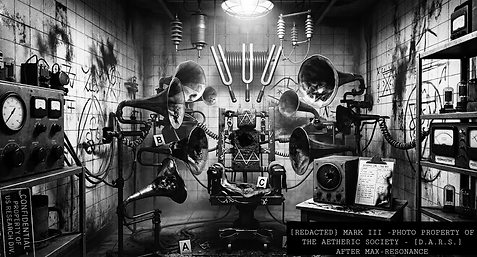
MARK III - [POST TEST]
Multiple high-threshold disappearances left behind:
Scorched chairs
Fused sacred geometry
Burn patterns inconsistent with known heat sources
and chamber floor markings resembling incomplete sigils or collapsed harmonic diagrams.
No complete biological remains were recovered in these cases.
Apparatus Legacy
Several early chamber designs are attributed to extrapolations from Samuel Spengler’s resonance theories, though internal review remains divided on whether Samuel intended these machines for therapeutic use, spiritual contact, or controlled observation only.
Later generations altered and weaponized the underlying framework into more aggressive induction architecture.
Because of this lineage, D.A.R.S. remains informally referred to as The Spengler Legacy.

Choir Anomaly Recording Initiative
In parallel with live subject testing, D.A.R.S. maintained an archival program to capture and analyze anomalous audio phenomena associated with chamber exposure, sleep-state resonance, and post-session recovery. These recordings include:
Layered choral textures
Subharmonic pulses
Repeated whispered phrases
Tonal structures not matching known instrumentation
and vocal signatures with no identifiable human source
Several recordings were marked for sealed retention after staff reported that playback alone produced:
Nausea
Temporal dislocation
Involuntary prayer
Visual distortion
and recurring dream content among unrelated listeners

Restricted Finding
At least one chamber session appears to have produced simultaneous remission of illness across multiple unrelated patients housed in adjacent rooms, despite only one subject undergoing direct exposure. This event was classified as non-repeatable and sealed. No accepted mechanism has been established.
Division Conclusion
Sustained resonance exposure produces measurable effects on physiology, cognition, emotional state, and threshold sensitivity. Under specific chamber conditions, harmonic induction appears capable of triggering symbolic recurrence, anomalous auditory perception, and irreversible over-attunement.
Internal Warning
D.A.R.S. does not recognize “angelic contact” as a valid research term. Personnel are nevertheless advised that subjects reporting choirs, bells, or direct verbal reassurance should be removed from exposure immediately. Continued contact after phrase recognition is associated with loss events, chamber burn-through, and non-recoverable disappearance.
Informal Staff Language
Though not recognized in official summary documents, internal staff terminology refers to advanced subjects and themes as:
Burn outs
"seeing the angels" or "Walk'en with Enoch"
and, in field shorthand, gone to register
