


Division of Mourning-State Research (D.M.S.R)
Codename: Signal House
Public Function
Studies grief susceptibility, residual emotional fields, and consciousness under extreme emotional pressure.
Internal Scope
The Division of Mourning-State Research maintains active surveillance over sites exhibiting abnormal concentrations of unresolved grief, symbolic recurrence, perceptual distortion, atmospheric instability, and threshold-softening behavior. Internal doctrine holds that mourning is not merely emotional fallout, but an environmental pressure capable of altering spatial continuity, cognitive reliability, and localized reality conditions.Signal House classifies these conditions as mourning-state saturation events and treats high-density grief as both a contaminant and a predictive field. Sites under review often present with recurring fog, object fixation, dream overlap, repeated symbols, road-loop phenomena, and structural hostility toward occupants.
Working Hypothesis
Under sufficient emotional load, grief ceases to remain personal and begins to externalize. Once externalized, it may present as:
Residual field density
Symbolic precipitation
Atmospheric recurrence
Perceptual sink
Unresolved dead-space
Environmental grief load
Basin formation
Signal House personnel are instructed to treat these effects as measurable, progressive, and potentially self-reinforcing.
Primary Registry Program
Aether-Watch / Thin Spot Registry
This division maintains a live registry of:
Residences
Churches
Hospitals
Rural road systems
and small-town zones
They are associated with:
Repeated death
Disappearance
Unresolved mourning
Ritual trauma
and long-term symbolic bleed.
Rather than neutralize these environments, approved observation teams preserve and, in certain cases, intensify site conditions through controlled reintroduction of:
Emotionally charged objects
Correspondence
Recordings
Family artifacts,
and visual triggers.
The purpose of this method is to document the point at which grief transitions from psychological residue into architectural or environmental distortion.
Observed outcomes include:
Repeated apparitions linked to specific loss events
Localized fog
Formation without meteorological causedream-sharing among unrelated occupants
Recurring symbols across multiple surfaces and structures
Road misdirection and loop-return behavior
Transient changes in floor plan logic
Disappearances following object reactivation
Increasing hostility from the site itself

CONTAMINATION RANKING
RANK I - THIN SPOT
RANK II - LOCALIZED SOFTENING
RANK III - THRESHOLD BREACH
RANK IV - BASIN EVENT
--- "HAUNTED" HIGHWAY
Appalachian Sector Registry — Partial Flags
Sites in the Appalachia presently include thin spot, distortion, and basin classifications associated with:
Misty Pines
Saints Hollow
Ash Grove
Rouge Valley
Green Acres
Highway 7 in Dugan County A.K.A. "The Baby Fever Incident"
This corridor has been nicknamed "The Demonic Bible Belt". Several of these locations demonstrate overlap between mourning-state saturation and broader symbolic contamination models.
At least one site remains under sealed review following a church-centered rupture event involving ritual violence, grief concentration, and breach-level environmental collapse.
CONTAMINATION RANKING
Class I — Residual Atmosphere
Mild recurrence, object attachment, emotionally charged dreams, low-level symbolic bleed.
Class II — Localized Distortion
Fog events, visual echo, repeated insignia, auditory anomalies, minor time-slip reports.
Class III — Threshold Softening
Road loops, disappearance zones, repeated apparitions, dream crossover, unstable location memory.
Class IV — Basin Event
Town-scale contamination, symbolic weather, structural predation, environmental hostility, civic destabilization.
Class V — Breach Condition
Spiritual rupture, ritual instability, portal behavior, multi-casualty anomaly zone, non-local intrusion.

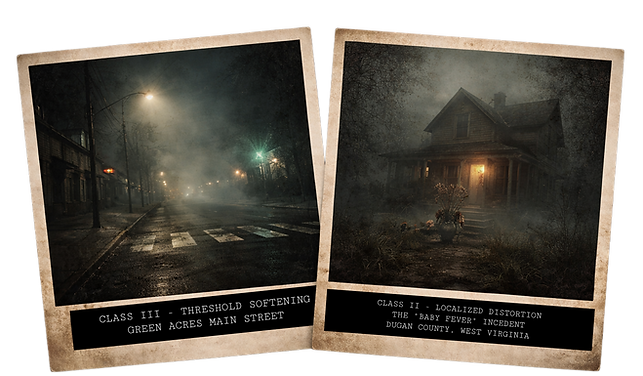
Green Acres Addendum — Sealed
Signal House records indicate a rapid escalation from localized distortion to full breach condition in Green Acres, Pennsylvania, culminating in town-wide perceptual instability, symbolic recurrence, and a church-centered event now cross-filed under restricted holdings. Post-event evidence suggests the environment did not merely reflect grief, but began organizing itself around it.

Class V — Breach Condition
Division Conclusion
Severe grief produces measurable atmospheric and spatial effects. In advanced cases, mourning-state saturation gives rise to symbolic weather systems, threshold softening, and basin events capable of destabilizing both subjects and sites.
Internal Warning
Signal House does not recognize “haunting” as a valid field term. Personnel are advised that locations under sustained mourning-state pressure may exhibit adaptive, predatory, or devouring behavior. Site attachment should not be mistaken for passivity.
