


Department of Convergence Events
Codename: The Vale Protocols
D.C.E. — INTERNAL SUMMARY[ARCHIVE RED ACCESS ONLY]
Where Signal House studies wounded places over time, D.C.E. studies the moment at which those wounds open.
OPERATIONAL PRINCIPLE
D.C.E. personnel are trained to interpret convergence not as haunting, possession, or supernatural intrusion, but as impact geometry:
the point at which enough unstable systems align to produce a measurable event affecting perception, time, memory, or material continuity.
This framework is not considered optional.
It is required for operational stability.
Symbolic density
Witness overlap
Emotional pressure
Threshold instability
Recurrence velocity
For internal use, the Department tracks convergence through five active indicators:
A site becomes actionable once three or more indicators rise simultaneously inside the same event window.


1987 [D.C.E.] AGENT SITE MAP

[D.C.E.] FIELD AGENT IN MISTY PINES
Agents are deployed to:
Active anomaly zones
Breached churches
Unstable roads
Ritual sites (unclassified)
Hospitals and institutional environments under threshold pressure
Post-incident witness clusters
Regions flagged by Signal House or Dream Logic as likely to rupture
Once deployed, teams establish:
Field tripods and survey markers
Magnetic and atmospheric monitors
Temporal drift recorders
Symbolic perimeter grids (classification disputed)
Witness interview stations
Convergence geometry charts
Personnel frequently remain on-site through the event itself.
FIELD ROLE
D.C.E. functions as the Society’s primary observation and stabilization arm.


RITUAL SITE EXAMPLES [A,B,C]
Field Incident of Note: Ash Grove
A D.C.E. observation team assigned to the Ash Grove corridor reported prolonged environmental inconsistency, repeated signal loss, and convergent witness descriptions involving an aerial or elevated presence not visible on standard review. One field agent continued filing handwritten notes from a mobile command unit after weather inversion and partial perimeter collapse. The site remained active beyond projected duration and was later reclassified for restricted review.


[D.C.E.] FIELD AGENT [REDACTED] - OCTOBER 31ST [REDACTED]

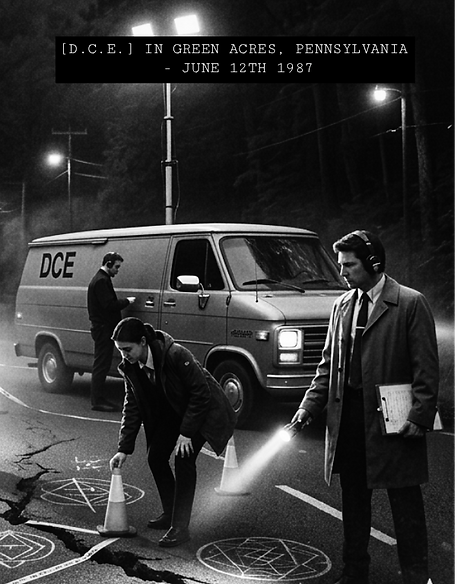
D.C.E. presence was established in Green Acres prior to full breach escalation under the assumption of localized psychological and environmental instability. Following ritual-site activation and town-wide symbolic recurrence, one field agent became separated from the extraction route and remained inside the active zone for an extended duration.
Recovered notes indicate continued attempts at mapping and equipment maintenance, despite total loss of stable site logic.
The event was later transferred to restricted holdings along with the [D.C.E.] Agent.
Field Incident of Note: Green Acres, Pennsylvania
MAIN STREET, GREEN ACRES,PENNSYLVANIA
OCTOBER 31ST, [REDACTED]- [AERIAL VIEW]


MAIN STREET, GREEN ACRES,PENNSYLVANIA
OCTOBER 31ST, [REDACTED]
[D.C.E.] AGENTS OUTSIDE THE GREEN ACRES BAPTIST CHURCH,
GREEN ACRES,PENNSYLVANIA
JULY 12TH, 1987

GREEN ACRES BAPTIST CHURCH, GREEN ACRES,PENNSYLVANIA [INTERIOR]
JULY 12TH, 1987
FIELD LANGUAGE (Unofficial)
Despite formal discouragement, D.C.E. personnel informally refer to active sites as:
Dead zones
Hell gates
Devils crossroads
Twilight zones
Bad alignments (legacy terminology)
Personnel with repeated exposure are sometimes referred to as: "The Damned"
Use of this terminology is discouraged, but persists.
PERSONNEL PROFILE
[Behavioural Review Summary]
D.C.E. agents typically identify as responders rather than enforcers.
They believe their role is to:
Understand
Stabilize
and prevent escalation
As a result, they tend to be:
Highly field-oriented
Improvisational
Resistant to rigid interpretation
and, in some cases, emotionally compromised through prolonged witness exposure
Archive Red [A.R.] assessment:
“D.C.E. remains effective within its parameters. Those parameters are incomplete.”
[D.C.E.] AGENTS [REDACTED], [REDACTED], AND [A.R.] AGENT [REDACTED]
LONG-TERM EXPOSURE CASES
Repeated live-event exposure has produced measurable cognitive and emotional degradation in D.C.E. personnel.
Common symptoms include:
Temporal confusion
Symbolic fixation
Insomnia
Humar as deflection
Compulsive note-taking and documentation
Dream contamination
Fixation with "Demons", "Ghosts", and the supernatural
and inappropriate attachment to unresolved sites
At least one field agent assigned to a hospital/asylum convergence zone remained trapped within the active site for over a year after entry.
Upon extraction the agent had to be examined and eventually cleared of active duty.

[D.C.E.] AGENT [REDACTED] - FINAL CONSULTATION
JUNE 11TH [REDACTED]
Restricted Finding
D.C.E. records indicate that convergence intensifies in the presence of:
Paired-recognition behavior
Narrative-linked memory recall
Pre-event familiarity between subjects
These cases are now cross-filed under restricted holdings.
Further access requires Archive Red clearance.
Further inquiry requires Archive Red clearance.
Division Conclusion
Convergence events are not isolated anomalies.
They are collision points—
formed when place, memory, symbol, environment, and subject history align under sufficient pressure to disrupt continuity.
They may be tracked.
They may be anticipated.
They cannot be reliably controlled.
Internal Warning
The Department does not recognize “angel,” “demon,” or “miracle” as valid field terms.
Personnel are nevertheless advised that repeated symbolic overlap, witness synchrony, and emotional recognition events should be treated as high-risk escalation markers.
If an event begins organizing itself faster than the team can map it, the site is to be abandoned immediately.
